The Message (Part 1 – Hidden Gems)

Don't Stop Believin' by Benjamin T. Collier https://benjaminfrog.com/

The message of your story, generally, is also tied very closely to your Core Concept, although the message may not always be obvious when you first start writing. I think it took me a while after I started writing Singularity before I understood what possible message I could give to people through it. It was honestly an afterthought, because my Core Concept was just to write an interesting story. I didn’t want the search for a ‘message’ to get in the way of that. But I did what I often do in such situations, and what surprisingly works for a lot of writers – I just wrote the story down and let the message reveal itself when it was ready.


(Avengers: Age of Ultron SPOILER ALERT sort of)


I don’t always start a story knowing ahead of time what the message will be. I don’t always have an agenda like that. But I’ve found that when I write authentically, meaning when I let characters and events flow naturally, messages usually come about on their own.

I hope that can be an encouragement to some of you. If you already know the message you want to communicate, then great. If not, I would say not to worry about it. Just write honestly. Odds are you or your characters will say something without realizing it, maybe even just through their actions rather than words, and your audience will be inspired in one way or another.

People are naturally inclined to find messages in things, even if the writer didn’t intentionally put anything there. Sometimes what the audience gets is completely different from what the writer intended (which could be a sign of bad writing, but we’ll get to that in future posts).

People are surprised when I talk about how many Jesus parallels I find in the movie Chronicles of Riddick. I am quite certain that it is not what the writers intended, but it’s what I see when I watch it.

Of course, being Christian is likely a big part of why I even saw those parallels in the first place, because I’m already used to thinking in ‘Christianese’ terms. Be aware that the same will go for your audience. Some may not see what you want them to see. They may walk away with a very different message depending on their own experiences and what they associate with what.
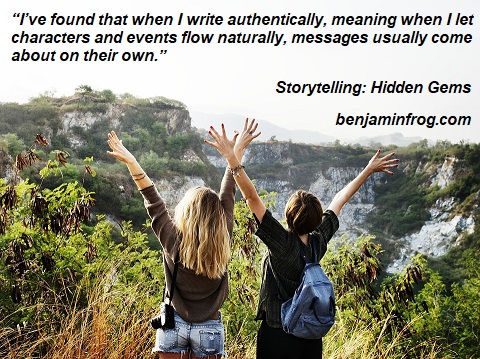
Storytelling. Hidden Gems. Message. Moral. benjaminfrog.com

I just recently watched Avengers: Age of Ultron with a specific view to what I sensed were messages about my personal struggles over the past few years. I have tried so hard to fix a particular issue in my life, and I’ve tried so many different ways, only to apparently make bigger messes. And I’ve worried a lot about how my unwise or misguided choices may have negatively impacted others. But now I recognize that everything is not my fault alone (in Age of Ultron there are many people to blame). Sometimes I played the blame game a bit too much. In the end though salvation comes, not necessarily through our own efforts, but through God taking our messes and knowing how to turn them around into something he can use to make things better.

Now, ask Joss Whedon if that’s the message he was trying to get across. Yeah, right! But that’s what I got out of it simply because that’s what my heart needed to hear at the time.


My next post will talk about how to communicate your Message without pushing away your audience.

For more on these and other writing topics, The Storyteller’s Handbook is available for purchase now.

 

Posted in Personal, Pop Culture, Spiritual, Storytelling, Writing | Tagged , , , , , , , | 1 Comment

The ‘What If’

Morpheus What If I Told You

Every work of fiction is a ‘What If’. With Science Fiction the What If is more obvious. “What if we had the ability to travel back in time?” “What if we could bring dinosaurs back?” “What if we could clone ourselves instead of having children?” But even contemporary fiction has a What If when you look closely. “What if a guy began a relationship with his best friend, but then the girl he’s had a crush on for years suddenly shows an interest?” Whatever scenario the story is dealing with – that’s the What If. It’s more commonly known as the Premise. It’s a scenario that gets the reader wanting to follow the story to find out what happens. For that reason, you can usually find the What If or Premise by looking at the synopsis on the back of the book, or the back of the DVD case.


(Star Wars and The Matrix Spoiler Alert)


There are two things every story needs to do with the What If in order to be a great story: the story needs to take the What If to its natural conclusion, and then not stay there – to take it a Step Further. If the What If is not properly addressed, by taking it to its natural conclusion, then the audience will feel like you haven’t done the premise justice. Because you haven’t. You’ve avoided the reality of what would naturally happen. You need to at least go there, even if only temporarily or as a trick, in order to show your audience that you know what you’re talking about and that you plan on dealing with the issue in a believable manner.

On the other hand, ending the story with the natural conclusion can be predictable and boring, and often times a bummer. This is why it’s a good idea to ‘not stay there’ and take it that ‘Step Further’ once the natural conclusion has been addressed. At least, don’t stay in the natural conclusion for too long.

If I wrote a novel in which someone arranged to have me get into a fight with Bruce Lee, the What If is: “What if I got into a fight with Bruce Lee?” And the natural conclusion is: Bruce Lee wins. If I don’t at least let the story go there, then the audience will feel like I’m not being realistic with the premise.

But that conclusion is also very predictable and makes for a boring story. But the Step Further could be that just when it looks as though I’m about to lose I get up and say “Aha! But little did anyone know that this whole time I’ve been secretly training under Chuck Norris!” In which case I still lose, but you get the idea.

Storytelling. The What If. Premise. benjaminfrog.com

Most What Ifs involve impossible odds, because stories aren’t usually exciting otherwise. And the natural conclusion to impossible odds is that the hero loses. The story has to at least make it look as though things are heading in that direction, because otherwise the audience will feel like the story is unrealistic. The Step Further usually involves some last-minute piece of inspiration or motivation that pushes the hero to go further, delivering the one good punch that knocks down the villain. Those are the kinds of endings that audiences generally want, because we want to believe that we can face impossible odds too, and overcome them, even if we (understandably) seem to be losing a lot of the time.

Neo takes on an Agent for the first time. Everyone has been told to avoid Agents because they’re impossible to kill, even for Neo. The natural conclusion is Neo dies. The Step Further is that Neo had to die in order to fulfill a prophecy about him being The One. He comes back to life, seeing the Matrix for what it really is, and is able to destroy the Agents with no effort whatsoever.

Luke Sywalker takes on both Darth Vader and the Emperor. The natural conclusion is he’s no match for the Emperor’s power (at least not after using up his energy on fighting his father). The Step Further is that Vader’s heart is turned, and Vader himself takes out the Emperor to save his son.


My next post will begin a three-part series on how to get The Message of your story across more effectively.

For more on these and other writing topics, The Storyteller’s Handbook is available for purchase now.


Posted in Pop Culture, Storytelling, Writing | Tagged , , , , | 1 Comment

The Core Concept

‘Jenga’ credit Claus Rebler https://www.flickr.com/photos/zunami/3160114349

The Core Concept is the first thing to establish when you set to work on your story, because it lays the groundwork for every other idea you might have for it. I’m not saying you need to make a Core Concept – if you have even a basic idea of a story then your Core Concept likely already exists. The important thing is to identify it. If you don’t know what your Core Concept is then you run the risk of making decisions that don’t fit the foundation of your whole idea – or worse – you run the risk of throwing out the Core Concept in order to make room for what should be lower priorities, not realizing that you’ve tossed out the very foundation of your entire story, and then you may wonder why nothing looks like what you had originally set out to do.


The thing to ask yourself is: why do you want to write this story? Why is it the one to come to your mind when you think of a story that you want everyone to experience? If you dig deep, there is usually a reason. Something you personally are passionate about.

Your Core Concept may be a particular character, in which case the story would very likely revolve around them. It may be a particular kind of world, dealing with certain laws of government or laws of physics. A particular kind of plot twist that you think no one will see coming. For me, it is usually an emotion – a particular thing I want the reader to feel at some point in the story and I can only think of so many ways to take the reader to that place, which gives me my foundation and my direction for how to tell the story.

Once you know what your Core Concept is, try to look at it as the foundation on which all the rest of the story is built. Every time you have an idea of something to add to the story or something to change about it, ask yourself: “Does this help my Core Concept, or work against it?” This principle of Core Concepts applies to individual elements like characters as well. Is your character shy? Then don’t have them opening up to complete strangers, even if that’s needed in order to make something else work. Is your planet fertile? Then don’t position it too far from or too close to the sun. Is your character a highly trained swordsman? Then don’t give them a background where they’ve had no time to train. Even if it feels necessary in order to make some other aspect of the story work – if it interferes with the Core Concept, with the very foundation on which everything else is built, then it’s not that important.

Storytelling. The Core Concept. benjaminfrog.com

If you’re not sure what your foundation is for certain characters, events, locations or any other aspect of the story, and so you’re not sure if an idea is contradicting a foundation or not, a good question to ask is: “How do I want people to feel when they think of this character/event/location?” And then when considering new ideas, ask yourself: “Would this help or hurt the way that I want people to feel when they think about this character/event/location?” If you want people to think of a particular character as pure-hearted, then don’t have them thinking or saying lewd things. If you want people to feel regret when looking back on a particular event, then don’t have things result from that event that make people happy and that could only possibly have happened because of that event. If you want people to associate a particular location with peace and joy, then don’t have a tragic event unfold there. Asking the simple question of “How do I want people to feel about this?” is an important habit to get into.

As great as the recent Star Trek reboot films have been, there is a nagging problem I have with them. None of the films are really about exploring the stars – which had been the whole point of Star Trek since its beginning in 1966. The recent films have very little to do with exploring new territories. They’re boldly going where people have already been. They dropped the Core Concept.


In many cases, the story’s Core Concept is either very simply the What If, or it is very closely related to it. So I’ll talk about that in the next blog post.


Top Photo ‘Jenga’ credit Claus Rebler under Creative Commons license


For more on these and other writing topics, The Storyteller’s Handbook is available for purchase now.


Posted in Storytelling, Writing | Tagged , , , | 2 Comments

New Focus

I’ve been particularly quiet on my blog for the past while. Part of that was because of focusing on book publications – editing and revision work. Another reason though has been new writing prompts and projects that haven’t reached completion yet.

It’s been on my heart lately to talk more about writing – specifically about the art of storytelling. I’ve been collecting information over the years from all the things I’ve been reading and watching, and there are certain things I’ve noticed that feed into a good story, and other things that backfire.

I’ve already assembled a book to talk about these elements in detail, but since I’m into my sabbath year now I’m not looking to publish another book until 2018. That leaves me wide open for doing blog posts though. (Update: The Storyteller’s Handbook is now available for purchase!)

So what I’ve decided to do is take some samples of the notes I’ve taken on the art of storytelling and put them into blog posts over the next little while. I’ll do a short series on a number of topics, including hero types and villain types, and how writers can get their messages across more effectively through the stories they tell.


I’ll be doing my first post about storytelling soon. I’ll start with some of the more foundational aspects of building a story (like how to establish your focus for the story and make sure you stay on track) since it’s an element that a lot of us find challenging but it’s generally the best starting point for putting a story together.


My intention is for these posts to be beneficial for writers on all levels of experience. The kind of issues I’ll be pointing out are mistakes that I see made by even the most renowned writers, but the tips are simple enough to pick up on any stage in the journey. The research process and the insights I’ve learned have definitely helped me grow as a writer, and I hope they’ll be helpful to my fellow storytellers also.

Posted in Personal, Writing | Tagged , | 1 Comment

Existential Quandary

space-624054_960_720

That’s what I would call it. I’d had an ‘Existential Crisis’ before, and it certainly felt like one. This one didn’t feel quite so intense. Although I recognized the depth of the question to be the same kind of depth that caused my crisis back in my twenties – I wasn’t in quite so much of a panic this time around. I felt the capacity for panic, but not the risk of it. It’s hard to explain, but I think ultimately the difference was trust. I had been down this kind of road before, and last time God got me through. Better than that, the journey actually ended with God being more glorified in my mind than He ever had been before. So I wasn’t worried when this new line of questioning came my way. I acknowledged it. I realized I didn’t immediately have a solution. And I allowed it to be. I just let it sit. Let it hang there. I knew an answer existed, and it would come to me when the time was right.


The more recent question had to do with the nature of “prime reality”, or what reality naturally is without intervention. The issue my mind was wrestling with was the assumption that, all things being equal (meaning if nobody and nothing was getting any help from anything or anyone) reality would naturally lean toward complete nothingness, and that the existence of God was some sort of extremely fortunate aberration.


That question hung on my mind for over a month. I wouldn’t say it was a difficult month, but I was quieter during that time. At the same time the fact of having an unanswered question brought to mind its own question of ‘was I being prideful?’ Was this one of those things where I’m just supposed to accept that I can’t understand and surrender to God’s sovereignty? Well absolutely God is sovereign. I didn’t need the question answered or unanswered in order to have that perspective. To me, that wasn’t the issue. The issue was that ignoring the question would have felt like a cop out. This question had been brought to my mind, and I felt a responsibility to acknowledge it and do it justice.

I had grown up with similar questions in my mind, and I had gotten used to thinking that I had to get rid of those thoughts because they would anger God. I think in the back of my mind I always worried that if God can read my mind, and he reads my mind as I’m wondering how it’s possible for him to exist, then he’ll go “Holy crap, he’s right! Where did I come from?” and then go in a corner somewhere rocking and sucking his thumb and then all of reality will crumble.

I suppose there was at least a bit of trust in play as well. It wasn’t so much that I needed to understand everything (because I had already drawn the conclusion that a finite mind can never fully comprehend an infinite God) but I needed to know that God understood His own existence. But I keep finding that when I go for nature walks, when I surround myself with His creation and see the work of His mind, He simply does not come across as someone who’s freaking out from an existential crisis.

Which takes me back to the question of ‘is it okay to be asking these deep questions about the nature of reality in the first place?’ To which I eventually drew this conclusion: If God is a God of order (as opposed to chaos), which I believe He is, and if when God created us He determined both our capabilities and our limitations, then if He has given us a mind that is capable of asking the question then He has also given us a mind that is capable of understanding at least part of the answer.

Again, to understand everything simply will never be possible for a finite mind. But I believe it is possible to understand enough to be satisfied. So if God allows the question, then at the very least a satisfactory answer must be possible. What is satisfactory depends on the individual. What is satisfactory for me may not help a mind that has been asking far deeper questions. More over, by realizing that my concern was at least partially a trust thing (wondering if God understood the answer Himself) then by ignoring the question I would be in fact saying to God “I don’t believe you have an answer.” So in fact, by allowing my mind to ask the question I was showing trust in God, even if the answer didn’t come for some time.


I wrestled with it for over a month before a phrase popped into my head. “Non-existence is less natural than God’s existence.” I’m sure a trained theologian could put it into more accurate words, but it seemed to be the phrase that I needed to get my mind looking at the dilemma from the right angle. Then God reminded me of something I had actually blogged about a few years ago in a post titled Hypothetical Theological Debate.


In Genesis it says “In the beginning, God created the heaven and the earth.” and then it says, “The earth was without form and void”. There’s something in this passage that I think a lot of modern readers miss. I was raised Christian, but I was also raised in a world of science which tends to approach everything from a naturalistic perspective. And as such, I somehow got it into my head that the emptiness that existed before Creation was something that had always been, and that God somehow ‘came about’ and made the cosmos out of the nothingness that was already there, which means God was somehow either existing alongside the nothingness or he was a product of it. What this verse tells me is that even the nothingness that a lot of us tend to think of as prime reality, this absence of existence, is in itself something created by God. God made an empty space in which to create things, he didn’t come into existence in an empty space and then make other things. God was, at one point, all there was. There was nothing that was not God. No earth, no heaven, no void, just God. Nothingness was not even a thing until God allowed it to be. Needless to say that changed my perspective.

I didn’t realize it until after, but what was happening was a kind of imaginary fight between God and Non-existence over the “throne” of Prime Reality. God won. He didn’t even have to try. It felt like it had been a battle, and I think I came away from it feeling the joy of victory because of that. God was triumphant. I don’t often get a personal sense of God being the mighty warrior that I know He is. It seems a bit odd that it would take something like this to make me more aware of it, but I’ve learned that intellectual study is one of my passions, so of course God would use that to reach my heart.

Posted in Personal, Spiritual | Tagged , , , | 2 Comments

Existential Crisis

Space 5519580228_8dc57d7b3f_b

I’ve been reading a book titled The Universe Next Door by James W. Sire. It gives exhaustive descriptions of various world views (as many as he was aware of back in the day) talking about how to address various relevant questions like: Is there a God? What is God like? Why do we exist? What happens after death? Pretty deep stuff. Since I’m trying to understand the way different people approach these questions this kind of book was right up my alley, and I recommend it to anyone looking to understand the plethora of world views out there. (Warning: he uses a lot of big words. I myself understood about half of it.)

When it came to the section on Existentialism it reminded me of an occurrence in my twenties, which I think would be accurately described as an existential crisis. The train of thought also caused me to consider other questions that I hadn’t before, which I’d like to discuss in detail in a later post. For now, I feel like just sharing this story from when I was 23. I’ve documented portions of the experience in my personal journal.

As a child I was in the habit of freaking out whenever my brain tried to comprehend anything that was essentially infinite. I guess the way that my brain worked was that I needed to be able to contain information inside my mind in order for it to make sense, so the idea of an infinite universe really bothered me because if it was infinite (meaning without end) then I couldn’t possibly contain it, nor could I ever hope to. The same thing happened whenever I tried to understand Christian concepts like “eternal life” or “God had no beginning”. The idea of living forever used to terrify me because I couldn’t see that far ahead, and God having no beginning required trying to fathom that far back into a timeline that needed to end somewhere. As a child the only thing I could do to move on with my mind was ignore the questions, but as an adult that option felt too much like a cop out.


April 10, 2007

“It’s happened again, my mind has tried to grasp the infinite. Where did God come from? How did God come to be? The Bible says that He always has been – but isn’t that against the rules? What ‘rules’? God created all things. If there was ever a time He wasn’t around there would’ve been no rules to break. It’s no use trying to explain God’s existence through science because He created science. How could something He made be responsible for His existence? Something cannot come out of nothing. But by this logic nothing should exist at all.”


I remember more or less where I was at the time. I was at home. I remember that much. I think I was going back and forth through the house looking for something to do – something to take my mind off of it.

It had taken quite a few years, but my mind had finally touched on a very key factor in this whole line of questioning, and I could ignore it no longer. I shut myself in the bathroom, but that was probably a mistake. Isolation just made the realization louder. All of reality as I knew it operated on basic, fundamental and irreplaceable laws of cause and effect. Nothing can exist without something else causing it to exist. Logically, if you take this far enough back, you end up with a paradox. I finally realized that it was literally impossible for anything to exist – including myself. I’m not sure I can get this across strongly enough. It wasn’t possible for anything to exist. This wasn’t a logical conclusion. This wasn’t a thought or a feeling. I knew, without question, it is impossible for anything to exist.

I don’t perfectly remember what happened next. I think I blacked out. I could be wrong, because I don’t remember. But the fact that I don’t remember is possibly an indication that I blacked out. The next thing I remember was lying on the bathroom floor. I remember feeling the cold, hard tiles on my skin. I remember how solid they were, and I remember how much that surprised me. My realization that it was impossible for them to exist had no impact whatsoever on their existence. They remained as hard and solid as ever before.

I concluded two things from this. One – the universe I live in is sustained by something or someone other than myself. (Because if my mental breakdown doesn’t even have the slightest effect on something as insignificant as bathroom tiles then how can I conclude that I’m sustaining this whole universe myself?) And two – there must exist something in this universe or another that exists outside of my understanding of the laws of cause and effect.

The second conclusion touches on something philosophers have been trying to pin down for a while – the need for a Prime Mover. If everything comes from something, then when you eventually go far enough back you have to find something that was the first cause of everything else. For naturalists, even the Big Bang theory doesn’t quite satisfy, though it comes close, but even that still needs something before it to spark it. For theists the question of the Prime Mover seems easy – it’s God. But whatever answer one settles on, ultimately fails to satisfy as long as the understood laws of cause and effect are still applied. What I ended up having to conclude was that God is something outside of those laws as I know them. And if God is not the answer, then whatever the answer is must be something that exists outside of those laws. For me, being Christian my whole life, it was an easy transition to simply assume that God was even bigger than I had previously thought.


“As much as this thought freaks me out I am actually stumbling into a state of worship. Because I am here. Despite all logic on how things should work – according to my ‘rules’ – I am very much here, and alive, and thinking. If this were all an illusion it would’ve ended by now. This line of thought has brought me to a place of panic and instability that I had never known before and at the same time a place of reverence.

If I were holding this reality together in my mind as some people suggest then it would have shattered during this episode but the LORD has sustained it – He has sustained me.

I have tried so long and so hard to analyze God and explain Him but He is so much bigger than my understanding, my logic and my rules. My inability to grasp this is just one of the reasons that God is God and I’m not, and for that He is worthy of reverence and praise.”


I wanted to share that story first. There’s another more recent episode that I’d like to share in a future blog post, but I figure this one on its own may be heavy enough for one day.

Posted in Personal, Spiritual | Tagged , , , | Leave a comment

A Time For Heroes

My biggest concern throughout this election process has been the messages behind it. I personally wasn’t keen on either candidate, and anticipated a difficult four years ahead regardless of the election results. My primary concern was the messages being sent by the voters.

We’ve been living in an era of progress – of empowered women – of men of strong character. And I believe that’s what most people want. Now suddenly the world is not so certain what we want.

I know there were many dynamics to this election. It’s not like Hilary was perfect either. I don’t believe the majority of Trump supporters voted for him because of the racism, sexism, bigotry and bullying. I don’t believe that’s what his voters were supporting, and I don’t begrudge anyone for their choices. That’s beside the point now. My primary concern is what it has always been – the message.

Intentional or not, the election of Trump sent a message to Americans and to the rest of the world. The message that this stuff is okay. That this stuff is encouraged and supported. That this will get you places. There are entire generations growing up today that have awoken to a world where that is the message they’ve received. What are they to make of that? Parents have a more difficult job than ever to encourage their children to grow up to be respectful, tolerant and wise individuals.

So let me speak to the writers out there.

Writers, we’ve entered a time when it is more important than ever to write the kind of characters that you want your children to grow up to be, to give them heroes to look up to, examples to follow. We need more Aragorns today. We need more Katniss Everdeens. The upcoming generations will need more examples of men being strong men and women being strong women. Strong in character, not just physically or charismatically. They will need to see what it looks like for men to treat women respectfully. For women to be attractive without it being about their bodies.

Parents, write your female characters with the kind of strength and dignity that you want your daughters to have. Write the kind of male characters that you would actually be comfortable with your daughter dating (difficult as that might be). Write the kind of heroes you want your sons looking up to. They need to be shown that this is the ideal, that bigotry is what’s out of place, that sexual assault is wrong.

I’ve heard too many stories of women being assaulted and doing nothing about it because they thought it was normal. An entire generation has just been sent that message, and it needs to be countered. We need stories of women fighting back, speaking up, making a change, fighting for others.

Forget about the election. Forget about politics. Hating and blaming is pointless and not what I’m here to do. I know it was complicated and I won’t pretend to understand all the dynamics of it. All that stuff is behind us now. What we’re faced with now is a message. We need a response. We need examples to give to our kids – to our teens who are right now in the process of deciding what kind of person they want to be. We need heroes now more than ever. Writers, we have work to do.

Posted in Storytelling, Writing | Tagged , , | 2 Comments

Positive Reinforcement

I was feeling nostalgic for the original Borderlands game the other day, but after playing Borderlands: The Pre-Sequel for so long I had forgotten how much of a difference there is in sniping difficulty. I think the pre-sequel spoiled me and I just got used to sniping being a much easier thing. I’d also forgotten how excited the characters get when you accomplish something.


So I’m playing the original Borderlands  and I spot an enemy in the distance. He’s just standing there. He hasn’t noticed me yet. I take out my sniper rifle and aim for his head.


I miss.


He starts running toward me in a straight line.


I fire again. I miss.


I fire again. I miss.


By now he’s almost close enough to stab me, so I start backing up while continuing to fire.


I miss.


I fire again. I miss.


He swipes at me with his machete. He misses.


I fire. I miss.


I reload my sniper rifle because I’ve emptied the entire clip.


I fire again. I land a headshot, but it’s not good enough to kill him.


I aim for ANY part of his body. I graze his right arm and he dies.


My character: “Nailed it.”


Posted in Bite-Sized, Gaming | Tagged , , , , | 3 Comments

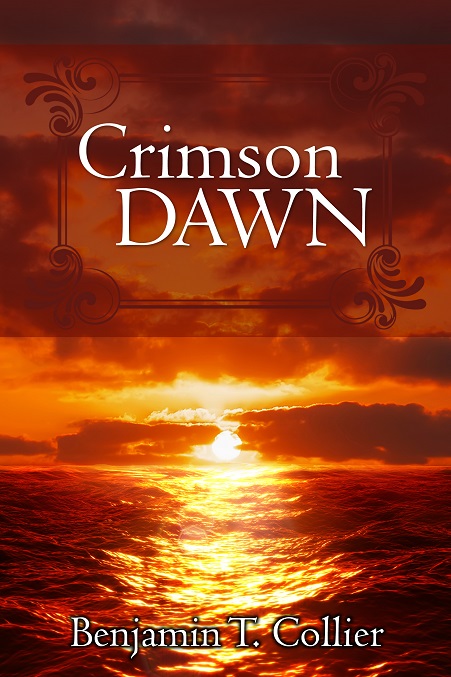
Crimson Dawn


Crimson Dawn. Fantasy Novel by Benjamin T. Collier. Sequel to The Kingdom


This project saw several delays, but I can finally say that the sequel to ‘The Kingdom’ is now published!

My new novel, ‘Crimson Dawn’ is a first for me in many ways. It’s my first published sequel; it’s my first published attempt at writing groups of characters rather than just a few at a time; and it’s my first published book with such a strong focus on combat. All of these are aspects of my writing style that I’ve yet to show to my readers, and I’m anxious to see the response.

I learned a lot from reader feedback on the first book, and tried to address those hopes and expectations in the sequel. My fans wanted a longer story. This one is more than double the length – although that’s not what I set out to do but the story kept expanding on me. My readers wanted to see more of the world. I have introduced characters from a variety of cultures in this sequel and taken time to talk a little about each. My fans want to know what happened to the wyvern “Ruth”. I made that the very first scene.

I hope my readers enjoy this story as much as I enjoyed writing it. It has been in the works for a while and there are some characters I have been very much looking forward to introducing to the fans. It is the encouraging words of my fans that inspires me to keep writing these adventures, so thank you guys. I hope I continue to earn the admiration you’ve shown me thus far.

To find ‘Crimson Dawn’ on Amazon, click here. Print copies can be ordered through Chapters/Indigo.

If you’re interested but haven’t yet seen the first book, click here

Posted in My Books, Personal, THE KINGDOM, Writing | Tagged , , , | Leave a comment

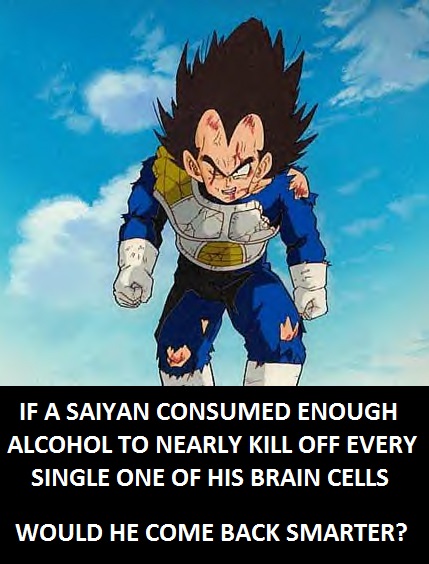
Deep Question #8

Vegeta. Saiyan. Dragon Ball Z logic. https://benjaminfrog.com/2016/08/10/deep-question-8/

Posted in Bite-Sized, Dragon Ball, Images | Tagged , , | Leave a comment